 Gondola Rides in Venice
What to Wear on a Gondola Ride in Venice
Last reviewed September 2026
What to wear on a gondola ride in Venice is a shorter question than it looks: nothing on the eleven gondola listings we track requires special clothing, and the ride itself provides nothing to wear beyond the seat you sit in. None of it changes between the Venice gondola rides we compare, because the boat and the step down into it are the same on all eleven. What trips people up is not fashion but footwear and the step down onto a floating pontoon. This guide covers what actually catches visitors out, what to pack for half an hour on the water, and the one dress code that does exist in Venice, though it belongs to a church rather than a boat.
Quick answer No dress code; flat shoes for the pontoon step, layers for the open basin
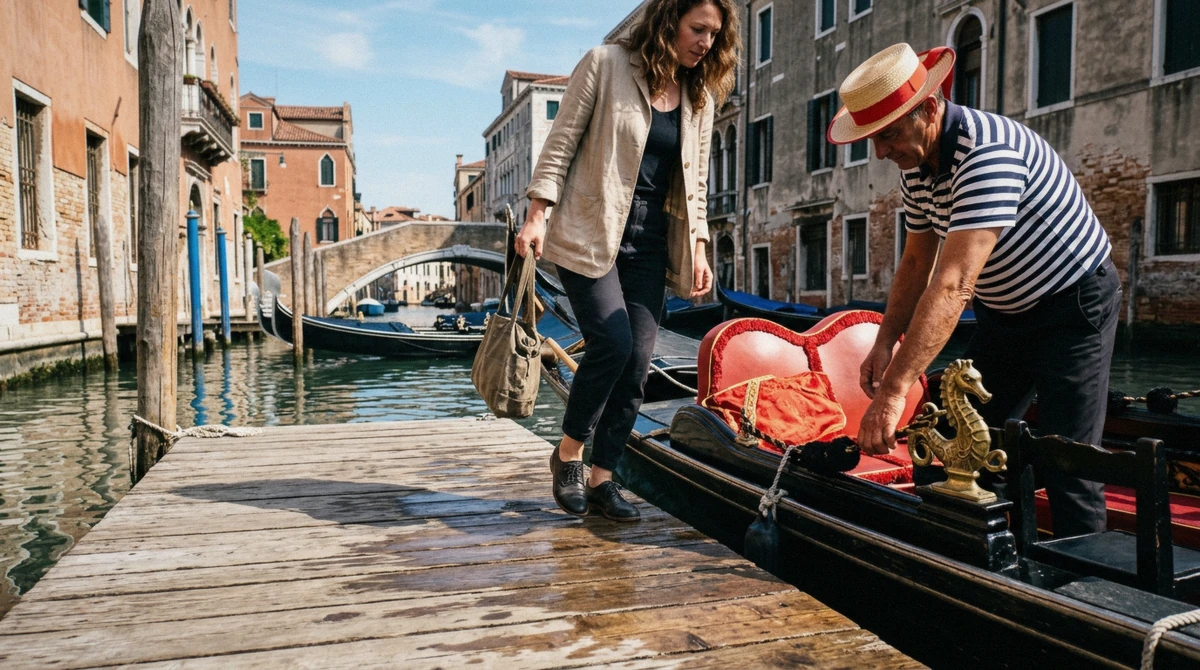
There is no dress code for a gondola ride in Venice. Wear what you would wear to walk the city that day. The one thing worth planning around is footwear: boarding is a step down from a floating pontoon into a seat set low in the hull, and heels or unsecured sandals are the real risk, not a style mistake. Pack for half an hour, not a day: most listings do not allow large bags aboard, and the boat has nowhere to put one.
Key takeaways
- No dress code applies to the gondola itself, the codes that do exist belong to St Mark's Basilica, not the boat
- Flat, secured shoes for the pontoon step down into a low seat
- Large bags are not allowed on most of the eleven rides we compare, pack light
- August highs average 27.6°C with no shade on the open basin; January lows average 1.5°C, colder on water than the same reading on land
- The exposed stretch is the open-basin crossing at Danieli, Molo or Dogana, most of a ride is shaded canal
- A light layer for the evening rate, which runs EUR 20 more after 19:00 than the same half hour by day
What to Wear: There Is No Dress Code, and What Actually Catches People Out
Searching what to wear on a gondola ride in Venice usually turns up advice written for a much grander occasion than a thirty-minute boat ride. The boat itself sets no rules at all.
Wear what you're already wearing that day
None of the eleven gondola rides we track states a clothing requirement of any kind. A gondolier's own uniform is regulated down to the width of his shirt stripes, but nothing in that regulation extends to passengers. Ordinary daywear, whatever it is that day in Venice, is fine for the boat.
What actually causes problems is not the outfit but two practical facts: the boarding step, covered below, and the sun on the open stretches of a ride. Both are about comfort and safety, not appearance.
The numbers behind that are small. The ride is 30 minutes, the boat holds 5 passengers, and August averages a high of 27.6 °C against 7.3 °C in January, so the whole decision is one layer either way. Booking is free to cancel up to 24 hours before, which means a change in the forecast is a cancellation rather than a packing problem.
Sun protection on the open basin
Rides that start at Danieli, Molo or Dogana cross open water before entering the shade of the narrow canals; rides from San Tomà or San Marcuola are inside shaded canals within a minute. A hat and sunscreen matter more on the first kind of route than the second, and August's average high of 27.6°C with no shade to speak of on the basin makes the difference noticeable. A rash guard or long sleeves is unnecessary for a half-hour sit, sunscreen and a hat cover it.
Winter is the opposite problem. January's average low is 1.5°C, and cold feels sharper sitting still over water than it does walking the same air temperature on land. A coat that's fine for a Venice street can feel thin for thirty motionless minutes on a gondola in January.
| Colour | Good? | Why |
|---|---|---|
| White | Context-dependent | Reflects summer heat well; shows dirt and canal spray on a stone quay |
| Black | Usually fine | No heat-reflection penalty on a thirty-minute ride; better for the after-19:00 slot when the light has already gone |
| Bright colours | Good | No safety reason to avoid them, a gondola isn't a wildlife-viewing trip where colour matters for the animals |
| Camouflage pattern | Avoid | Italy restricts civilian wear of military-pattern camouflage clothing; leave it packed for this trip |
| Earth tones | Neutral | No functional advantage on a gondola the way it has on a safari; wear them if you like them |
| Cotton | Fine for this ride specifically | The gondola stays dry in normal conditions, so cotton's usual quick-dry disadvantage doesn't apply here the way it would on a wet-immersion activity |
Shoes and the Pontoon Step
If one wardrobe question actually matters for a gondola ride, it's footwear: the reason is the boarding step rather than fashion.
Why the step matters more than the outfit
Boarding is a step down from a floating pontoon into a seat set low in the hull. The pontoon itself moves with the wash of every passing boat, so it is not a fixed platform the way a dock is. That movement, combined with a downward step, is what makes footwear the one wardrobe decision worth thinking about before a gondola ride.
The step itself is about 30 cm down from a pontoon that rises and falls with every passing boat, into a seat set low in a hull roughly 1.4 m wide. Flat soles solve it; nothing else you own has any effect on it at all.
- Flat, closed or securely strapped shoes, the safe default for the step down and for a seat with limited legroom
- Trainers or comfortable walking shoes, fine; this is the same footwear most visitors are already wearing to see Venice on foot
- Sandals with a back strap, acceptable, since the boat itself is dry and there's no water immersion involved
- Heels, the specific risk: a narrow heel can catch on a pontoon edge or slip on wet stone, right at the moment of stepping down onto a moving surface
- Flip-flops or any unsecured sandal, the same problem as heels for a different reason: nothing holding the shoe to the foot during a step onto a surface that isn't still
What to Bring
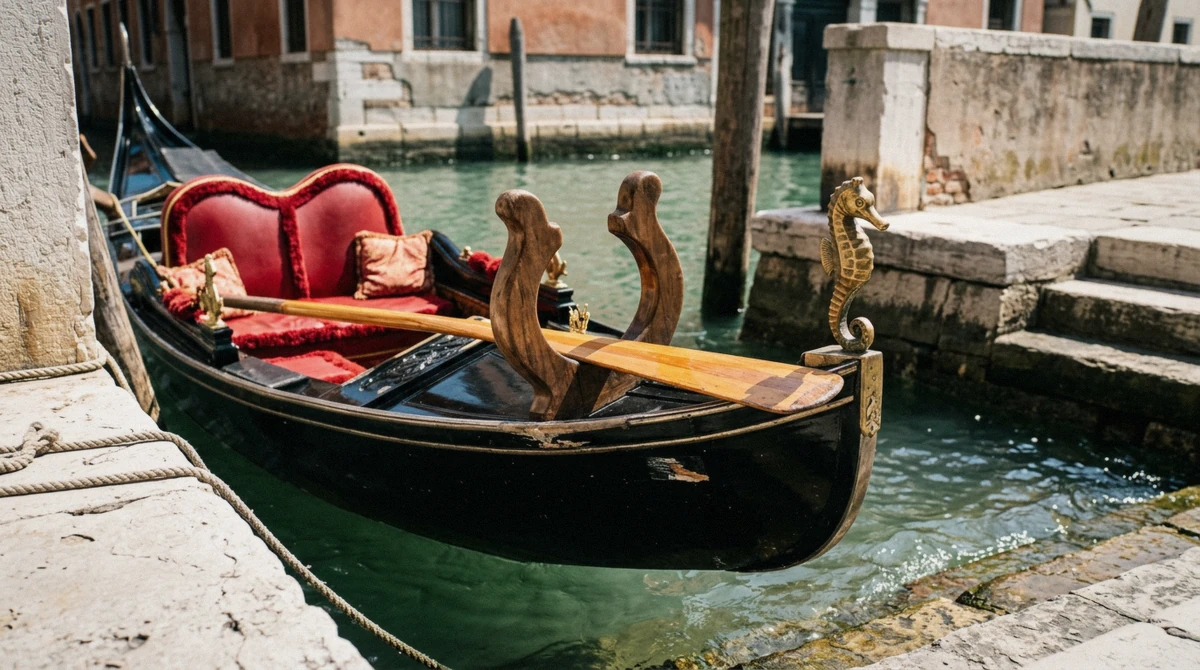
None of the eleven listings we compare supply passengers with gear of any kind, so everything below is on you, and none of it is heavy.
Pack for half an hour
A gondola ride runs thirty minutes by day and thirty-five after 19:00. Large bags are not allowed on most of the compared listings, and the boat has no storage beyond the seat itself, so the honest packing goal is a half-hour outing, not a day bag.
- Sunscreen, reapply before boarding, not during a ride with nowhere to sit it down
- Sunglasses, glare off open water on the basin crossings
- Small crossbody bag or pockets, large bags aren't allowed on most listings
- Phone or camera, charged, this is the photo half-hour of most Venice trips; one listing even brings its own photographer if you'd rather stay in front of the lens
- Cash, small bills, for a tip; card payment is compulsory for the fare itself but a tip is easiest in cash
- A light layer, evening rides run cooler once the sun drops, even in summer
- Hat, useful on the open-basin stretch, less so once the route enters shaded canals
- A coat in winter months, 1.5°C on the water in January feels colder than the same reading on a Venice street
- Water bottle, no service aboard on a thirty-minute ride
- Comfortable, secured shoes, see the pontoon step above; this is the one non-negotiable
Packing by Season in Venice
Venice's seasonal swing changes what's worth carrying onto a gondola; the full month-by-month climate picture lives on our best-time guide, here's what it means for what you wear.
Four seasons, four kits
Summer's problem is sun with no shade on the open basin; winter's is cold that reads harder on the water than on land. Spring and autumn sit in between but bring more rain days, so a compact umbrella earns its place in a small bag both seasons.
| Season | Wear this |
|---|---|
| Winter (December to February) | A proper coat, gloves, closed shoes; the daytime fare often buys the best light of the day since sunset falls before 19:00 |
| Spring (March to May) | A light jacket that layers off, closed shoes; bring a compact umbrella for the wetter spring weeks |
| Summer (June to August) | Light breathable clothing, sunglasses, a hat, sunscreen; no jacket needed even for an evening ride |
| Autumn (September to November) | A packable rain layer for the wettest stretch of the year |
The Dress Codes That Do Apply, and Where
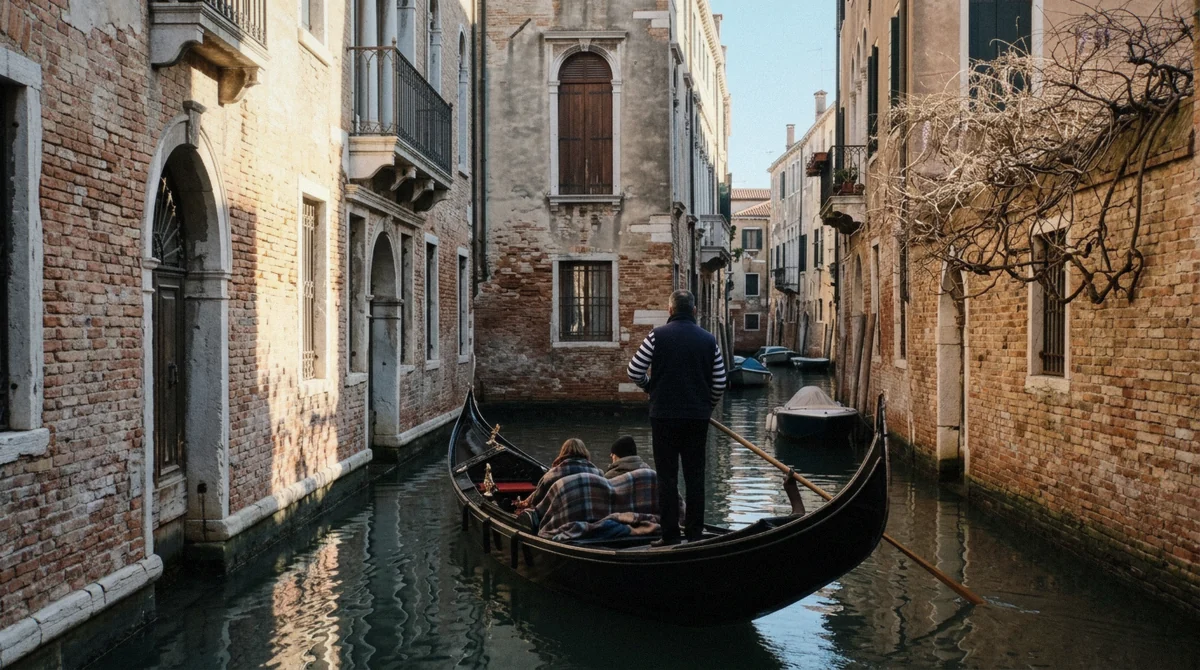
The gondola sets no rules. One building some combined tours enter does, and it's worth knowing before you book a listing that pairs a ride with a stop inside it.
St Mark's Basilica: covered shoulders and knees
Two of the compared listings pair a gondola with a stop that can include St Mark's Basilica, and the basilica enforces a real dress code: shoulders and knees covered, with a valid ID required for the timed-entry option. A scarf that covers shoulders and a knee-length hem or trousers clears it. This is a church rule, not a gondola rule, and it only matters if the specific tour you book includes that stop, check the itinerary rather than assume.
It doesn't apply at all to the ride under the Bridge of Sighs, which stays on the water throughout.
What Not to Bring, and What the Boat Does Not Have
The short list of what to leave behind matters as much as the packing list, since a gondola has nowhere to stash anything you shouldn't have brought.
Leave it behind
Large bags are not allowed on most of the eleven listings we compare, there is no under-seat storage or hold on a gondola, so anything bulky travels with you on your lap or not at all. Nobody may stand up during the ride, which rules out shooting video while walking around a boat that has no room to walk around in anyway. And the boat itself has no toilet, no shade beyond what the canal buildings provide, and no drinks service, a ride runs half an hour, so plan accordingly rather than pack for a longer outing than the one you've booked.
The Numbers Behind the Packing List
Everything above comes down to four figures: how hot it gets, how cold it gets, how long you are exposed and how much you can carry aboard. the municipal regulation fixes the last of those; the weather supplies the rest.
Temperature, month by month
Venice averages a daytime high of 27.6 degrees Celsius in August and 7.3 degrees in January, with overnight lows of 20.2 and 1.5 respectively. On the water in winter it reads colder than the same figure on land, because there is nothing between you and the wind for the length of a basin crossing.
Rain is not the problem people expect. November is the wettest month at about 126 mm across roughly eleven days with measurable rain, and gondolas run in the rain anyway. The months to dress carefully for are the two extremes, not the wet one.
| Month | Average high | Average low | Rain | What that means for what you wear |
|---|---|---|---|---|
| January | 7.3 C (45 F) | 1.5 C (34 F) | 65 mm | A coat, and something over your knees in the boat |
| April | 16.4 C (62 F) | 9.0 C (48 F) | 83 mm | A layer you can take off; the sun is already strong |
| July | 27.5 C (82 F) | 20.1 C (68 F) | 67 mm | Sun cover, and nothing that traps heat while seated |
| August | 27.6 C (82 F) | 20.2 C (68 F) | 84 mm | The hottest ride of the year, with no shade on the basin |
| November | 12.6 C (55 F) | 7.1 C (45 F) | 126 mm | The wettest month; a hood beats an umbrella in a boat |
What you may carry aboard
Large bags are not allowed on most of the compared listings, and the boat has no storage: what you bring sits on your lap for thirty minutes. Five passengers is the legal maximum under the municipal regulation, which also means five sets of hands and five laps in a hull about a metre and a half wide.
Pack for half an hour rather than a day. A phone, a card, sunglasses and one layer is the whole realistic list, and everything else is better left at the hotel than balanced on your knees.
What to Wear on a Gondola: Common Questions
Do I need water shoes for a gondola ride?
No. A gondola stays dry in normal conditions, so ordinary flat or closed shoes are all that's needed, see the footwear guidance above.
Is a gondola ride OK in a wetsuit or swimwear?
There's nothing to prevent it, but there's also no reason for it, the boat is dry and thirty minutes long. Ordinary daywear covers it.
What should I NOT bring on a gondola ride?
A large bag, since most listings don't allow one and there's nowhere to stow it. Beyond that, anything that needs standing up to use, nobody may stand during the ride.
Is a gondola ride OK for kids in terms of clothing?
Yes, no special clothing applies to children either. Our with-kids guide covers age and seating specifics beyond what to wear.
Do I need to dress up for a gondola ride to feel worth it?
No, what makes a gondola ride worth it has nothing to do with the outfit. Our is-it-worth-it guide covers what actually determines whether the half-hour pays off.
Can I wear jeans on a gondola ride?
Yes. Jeans are fine for a dry thirty-minute sit; there's no chafing or drying concern the way there would be on a water-immersion activity.
Can I wear shorts on a gondola ride?
Yes, with one caveat: if your itinerary includes a St Mark's Basilica stop, shorts above the knee won't clear that building's dress code, so bring a cover-up for that portion only.
What is the 3-3-3 rule for outfits, and does it apply here?
The 3-3-3 rule is a general travel-packing idea, three tops, three bottoms, three pairs of shoes for a trip, and it works fine for a Venice trip that includes a gondola, since the ride itself adds nothing to that list. The one addition worth making from the checklist above is a single pair of flat, secured shoes for the pontoon step, which most travellers already have in a 3-3-3 rotation anyway.
How many people fit in a gondola in Venice?
Five passengers is the maximum under the municipal regulation, and children and babies count towards that number the same as adults. Our with-kids guide covers what that means for a family booking.
Do gondolas provide life jackets or gear to wear?
No listing we compare mentions life jackets, and none should be assumed provided or required. The boat provides the seat and nothing else to wear.